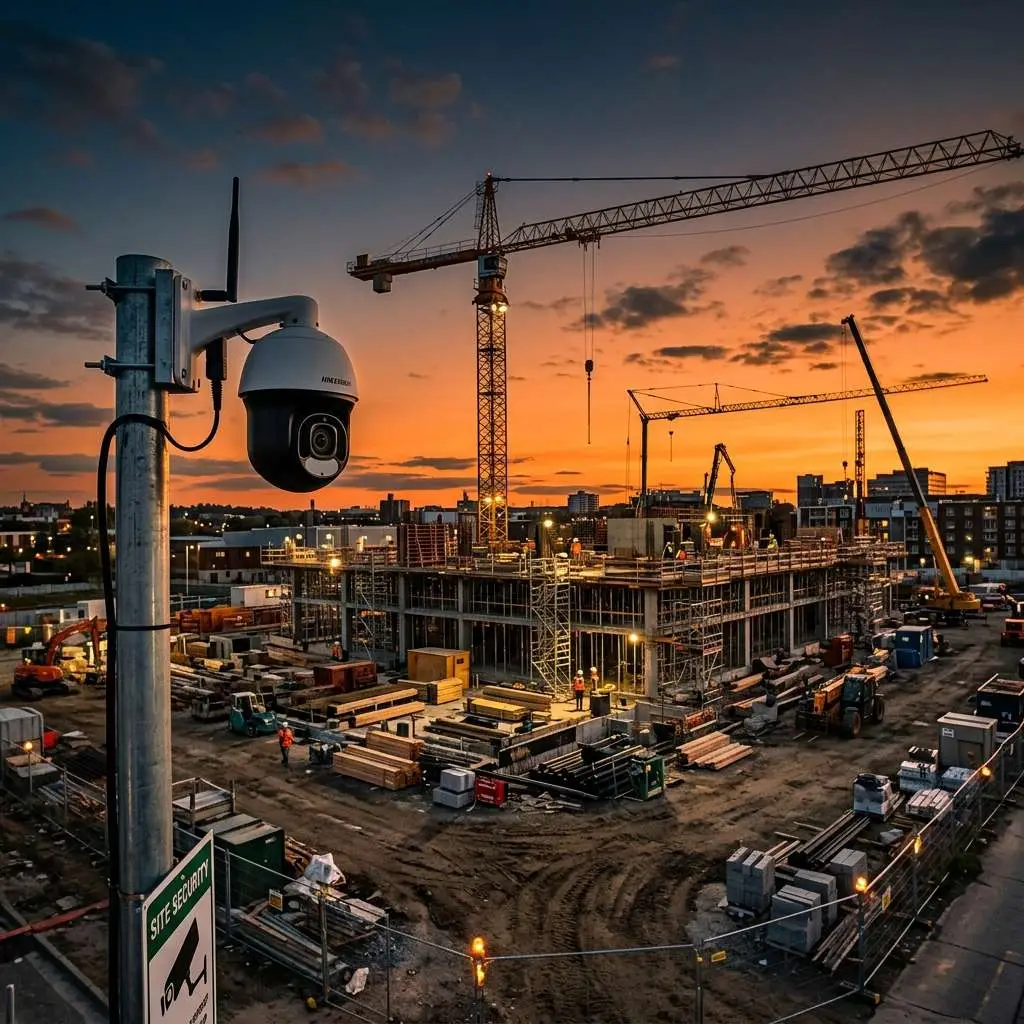
A half-built commercial building sitting unoccupied after dark is one of the easiest targets a thief will ever find. Copper wiring, heavy equipment, power tools, HVAC units, and raw materials can add up to hundreds of thousands of dollars in losses on a single job site across Metro Atlanta. For general contractors, developers, and construction managers operating along the I-285 corridor and throughout the Southeast, protecting an active construction site requires a security approach that adapts as fast as the build itself.
This guide walks through the cameras, monitoring strategies, and deployment methods that keep construction sites secure from groundbreaking through certificate of occupancy. Whether you are managing a single-family subdivision in Gwinnett County or a mixed-use development in Midtown, the principles here will help you choose the right combination of security camera systems and monitoring services for your project.
Why Construction Sites Are High-Value Targets
Construction sites combine high-value assets with minimal physical barriers, creating an environment that attracts opportunistic and organized theft alike. Understanding why these sites are targeted helps you build a security plan that addresses the actual risks rather than guessing.
The Economics of Construction Theft
The National Equipment Register and the National Insurance Crime Bureau estimate that construction equipment theft alone costs the industry between $300 million and $1 billion annually in the United States. In the Southeast, rapid development across Metro Atlanta, Charlotte, Nashville, and the Florida corridor has created a target-rich environment for organized theft rings.
Copper theft remains one of the most persistent problems. A new commercial building might have $30,000 to $80,000 worth of copper wiring and plumbing installed before the walls are even closed up. Thieves can strip an entire floor of copper in a single overnight visit, setting the project back weeks and adding significant cost overruns.
What Gets Stolen Most Often
- Copper wire, pipe, and HVAC components — easily stripped and sold at scrap yards
- Power tools and hand tools — cordless drills, saws, and generators disappear daily from unsecured sites
- Heavy equipment — skid steers, mini-excavators, and scissor lifts are driven off sites with no perimeter control
- Building materials — lumber, drywall, roofing materials, and fixtures staged for installation
- Fuel — diesel siphoned from equipment tanks, especially on rural or suburban sites
Beyond theft, construction sites face risks from vandalism, unauthorized entry, liability incidents, and arson. Each of these risks requires visibility that only a well-designed camera and monitoring system can provide.
Mobile Surveillance Trailers vs. Fixed Camera Systems
The first decision most contractors face is whether to deploy a mobile surveillance trailer or install a fixed camera system. The answer often depends on where the project stands in its timeline and what infrastructure is available on site.
When Mobile Surveillance Trailers Make Sense
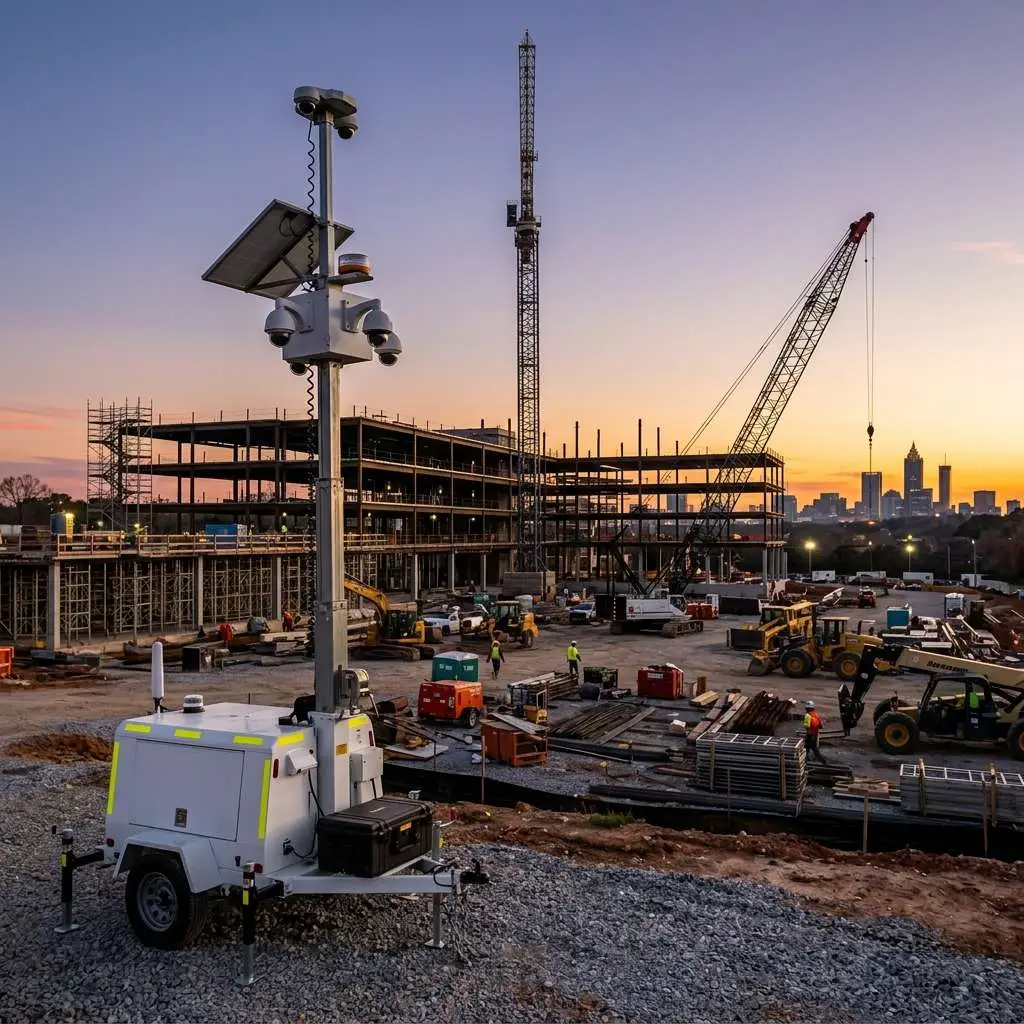
Mobile surveillance trailers are purpose-built, self-contained security units that arrive on a flatbed and start working the same day. They are the go-to choice for construction sites in the early phases of a project when no permanent power, internet, or structures exist to mount fixed cameras on.
A typical surveillance trailer from Edge CCTV includes multiple high-resolution cameras mounted on an extendable mast, solar panels, battery backup, cellular connectivity, and often integrated audio deterrence. The trailer can be repositioned as the site layout changes, making it ideal for projects where the active work zone moves across a large parcel.
Trailers work best for:
- Land clearing and site preparation phases
- Projects on raw land with no utility connections
- Short-term projects (3 to 12 months) where permanent installation is not cost-effective
- Remote job sites outside Metro Atlanta where cellular is the only connectivity option
- Multi-phase developments where the secured perimeter shifts regularly
When Fixed Camera Systems Make Sense
Once a project has permanent structures, electrical service, and network connectivity, a fixed commercial camera system becomes the more cost-effective long-term option. Fixed cameras provide higher resolution, more camera angles, and continuous recording to an on-site NVR or cloud storage.
Many contractors install fixed cameras during the rough-in phase and leave them in place as part of the finished building’s permanent security system. This approach spreads the cost of the security system across the construction budget and the building’s operational budget, saving the owner money on a post-construction security installation.
The Hybrid Approach
The most effective construction site security plans use both. A mobile trailer covers the perimeter and open areas during early construction phases, while fixed cameras are added to completed structures as the build progresses. Edge CCTV regularly deploys hybrid configurations for large commercial projects across Metro Atlanta, transitioning from trailer-only coverage to a full fixed system as the project reaches completion.
Solar and Cellular: Off-Grid Security Solutions
New construction sites rarely have power and internet available on day one. This used to mean that security cameras were impossible to deploy until utilities were connected, sometimes months into the project. Modern off-grid camera technology has eliminated that gap entirely.
Solar-Powered Camera Systems
Solar panels paired with deep-cycle batteries can power security cameras indefinitely in Georgia’s climate. Metro Atlanta averages 217 sunny days per year, providing more than enough solar energy to keep cameras and recording equipment running around the clock. Even during cloudy stretches in winter, properly sized battery banks maintain operation for several days without direct sunlight.
Solar-powered cameras are mounted on poles, trailer masts, or temporary structures and require zero electrical infrastructure. This makes them deployable on the first day of site work, before the first shovel hits the ground.
Cellular Connectivity
4G LTE and 5G cellular modems provide the network backbone for off-grid camera systems. These modems transmit video feeds to cloud storage and monitoring centers without any on-site internet connection. Coverage across Metro Atlanta and the I-285 corridor is strong with all major carriers, though rural sites in outlying counties may need directional antennas or signal boosters.
Cellular connectivity enables live remote viewing, real-time alerts, and virtual guard monitoring from day one of the project. Contractors and project managers can check camera feeds from their phones or tablets without ever being on site.
AI-Powered After-Hours Detection
Raw video footage is only useful if someone is watching it. Modern construction site cameras use artificial intelligence to analyze video feeds in real time and distinguish between genuine security threats and harmless activity. This dramatically reduces false alarms and ensures that real intrusions get immediate attention.
Human Detection vs. Nuisance Alerts
Construction sites are dynamic environments. Wind moves tarps and plastic sheeting. Animals wander through unfenced areas. Shadows shift as the sun moves. Headlights from passing traffic sweep across the site. All of these used to trigger motion-based alerts, creating a flood of false notifications that made security teams numb to real threats.
AI-powered analytics solve this problem by focusing specifically on human presence detection. The camera’s onboard processor analyzes the shape, movement pattern, and thermal signature of objects in the frame. When it identifies a person entering a restricted zone after hours, it triggers an alert. When a deer walks through the frame or a tarp flaps in the wind, it ignores it.
Perimeter Tripwire and Zone Intrusion
Virtual tripwires and zone intrusion detection let you define specific areas within the camera’s field of view that should be off-limits during certain hours. A camera watching a materials storage area can be programmed to alert only when someone crosses into that zone between 7 PM and 6 AM, ignoring all activity during working hours. This targeted approach keeps alert volumes manageable and response times fast.
Virtual Guard Monitoring for Job Sites
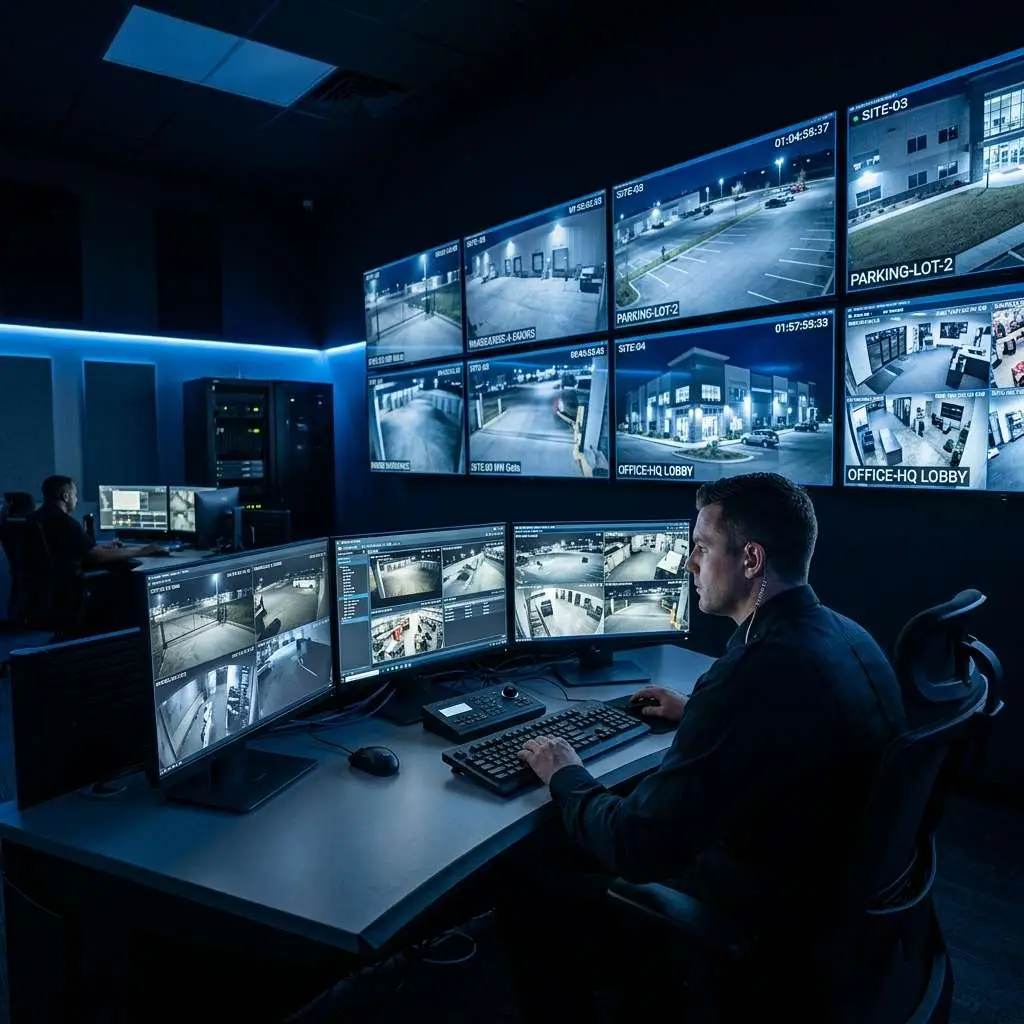
Cameras record evidence, but virtual guard monitoring prevents crime in progress. Virtual guard services connect your construction site cameras to a live monitoring center staffed by trained security operators who respond to alerts in real time.
How Virtual Guard Monitoring Works
When an AI-powered camera detects a person on your construction site after hours, the alert is immediately routed to a monitoring center. A trained operator views the live feed, assesses the situation, and takes action. The response follows a defined escalation protocol:
- Visual verification — the operator confirms the alert is a genuine intrusion, not a false alarm
- Audio deterrence — a live voice warning is broadcast through on-site speakers, addressing the intruder directly and warning them that they are being recorded
- Law enforcement dispatch — if the intruder does not leave, the operator contacts local police with the site address, a description of the intruder, and the direction of travel
- Client notification — the project manager or site supervisor receives a call, text, or app notification with a video clip of the incident
Why Audio Deterrence Works
Most construction site intruders expect to operate in the dark without anyone knowing they are there. When a loud, clear voice comes through a speaker telling them they have been identified and police are on the way, the vast majority flee immediately. This live intervention prevents the crime rather than just recording it for an insurance claim after the fact.
For Atlanta-area contractors, virtual guard monitoring is significantly less expensive than posting a physical security guard on site overnight. A guard costs $15 to $25 per hour, which adds up to $3,000 to $5,000 per month for overnight coverage on a single site. Virtual guard monitoring covers the same hours at a fraction of that cost and provides documented video evidence of every incident.
Camera Placement Strategy for Active Construction
Unlike a finished building where cameras are mounted once and left in place for years, a construction site is a moving target. The layout changes weekly as structures go up, materials are staged in different areas, and access points shift. Your camera placement strategy needs to account for this constant evolution.
Phase-Based Camera Deployment
Phase 1 — Site Prep and Foundation: During earthwork and foundation phases, the primary targets are equipment, fuel, and the site perimeter. Cameras on trailer masts or temporary poles cover the entire parcel from elevated positions. Two to four cameras on a single trailer can typically cover a 2 to 5 acre site during this phase.
Phase 2 — Framing and Rough-In: As structures take shape, the risk profile shifts to materials theft and copper stripping. Cameras move closer to the building and focus on material staging areas, tool storage containers, and building entry points. This is the phase where hybrid deployments begin, adding fixed cameras to the structure itself.
Phase 3 — Finishes and Closeout: The most valuable materials are now inside the building — fixtures, appliances, HVAC equipment, and finish materials. Interior cameras become critical. Fixed cameras installed during rough-in now serve their primary purpose, monitoring hallways, stairwells, and high-value storage areas.
Key Placement Principles
- Cover every access point — gates, gaps in fencing, and any area where vehicles or pedestrians can enter the site
- Overlap coverage zones — no single camera failure should create a blind spot
- Elevate cameras — higher mounting positions provide wider fields of view and are harder to tamper with
- Light the perimeter — IR illumination or low-voltage LED lighting dramatically improves nighttime image quality
- Protect the cameras — use vandal-resistant housings and tamper-detection alerts on all exposed units
Edge CCTV’s installation team conducts site assessments at each phase transition and repositions cameras to match the current risk profile. This proactive approach ensures continuous coverage without gaps as the site evolves.
Worker Safety and Incident Documentation
Construction site cameras serve a purpose beyond theft prevention. They are powerful tools for documenting workplace safety, resolving disputes, and protecting against liability claims.
Fall and Incident Documentation
Falls remain the leading cause of death in the construction industry, accounting for over a third of all construction fatalities according to OSHA. Camera footage provides an objective record of what happened before, during, and after any incident on site. This documentation is invaluable for:
- OSHA investigations — video evidence shows whether safety protocols were followed
- Workers’ compensation claims — footage helps verify the circumstances of an injury
- Subcontractor disputes — cameras document who was on site, what work was performed, and whether it met specifications
- Liability protection — if a trespasser is injured on your site, video showing they bypassed fencing and warning signs protects the contractor from negligence claims
Progress Monitoring
Many contractors use their security cameras for double duty, capturing time-lapse footage of the build for progress reporting, investor updates, and marketing. A camera positioned to capture the full building footprint can generate compelling before-and-after content while simultaneously serving as a security asset around the clock.
Delivery and Subcontractor Tracking
Cameras at the site entrance log every vehicle, delivery, and person entering and exiting the site. This creates an automatic record of material deliveries, subcontractor arrival and departure times, and visitor access. When a delivery goes missing or a subcontractor disputes their hours on site, the footage provides a definitive answer.
Why Atlanta Contractors Choose Edge CCTV
Metro Atlanta is in the middle of one of the largest construction booms in the Southeast. Residential subdivisions are pushing outward through Gwinnett, Forsyth, Cherokee, and Henry counties. Mixed-use developments are transforming corridors along I-285 and GA-400. Industrial and warehouse construction is booming along I-20 west toward Douglasville and east toward Conyers.
Edge CCTV works with general contractors, developers, and construction managers across this entire footprint. Our team understands the unique challenges of securing active construction sites in this region:
- Rapid deployment — we deliver and activate mobile surveillance trailers within days, not weeks
- Flexible contracts — rental terms that match your project timeline, whether it is a 4-month townhome build or a 2-year commercial development
- Hybrid system design — we transition sites from trailer-based coverage to permanent fixed cameras as the build progresses, often incorporating the security system into the finished building
- 24/7 virtual guard monitoring — live operators watching your site after hours with audio deterrence and police dispatch
- Local service — our installation and support teams are based in Metro Atlanta and can be on your site the same day for repositioning, maintenance, or troubleshooting
Whether you are breaking ground on a new subdivision off Sugarloaf Parkway or topping out a Class A office building in Buckhead, protecting your investment starts with the right security partner. Edge CCTV has the equipment, the monitoring infrastructure, and the local expertise to keep your construction site secure from the first stake to the final walkthrough.
Ready to secure your construction site? Contact Edge CCTV for a free site assessment. We will evaluate your project, recommend the right combination of cameras and monitoring, and have your site protected before the next shift begins.
For more on protecting construction sites from theft, see our Construction Site Theft Prevention Guide.
Related Guide
Explore security solutions tailored to your industry. See All Industries We Serve →

About the Author
Bobby Edwards is the Operations Manager at Edge CCTV, where he has been overseeing commercial security camera installations across the Southeast since 2014. A TRENDnet Certified Network Engineer (TNCE) and GA 811-credentialed technician, Bobby manages installation crews, designs camera layouts for new projects, and ensures every system meets the technical standards that keep it running for years. More from Bobby Edwards.