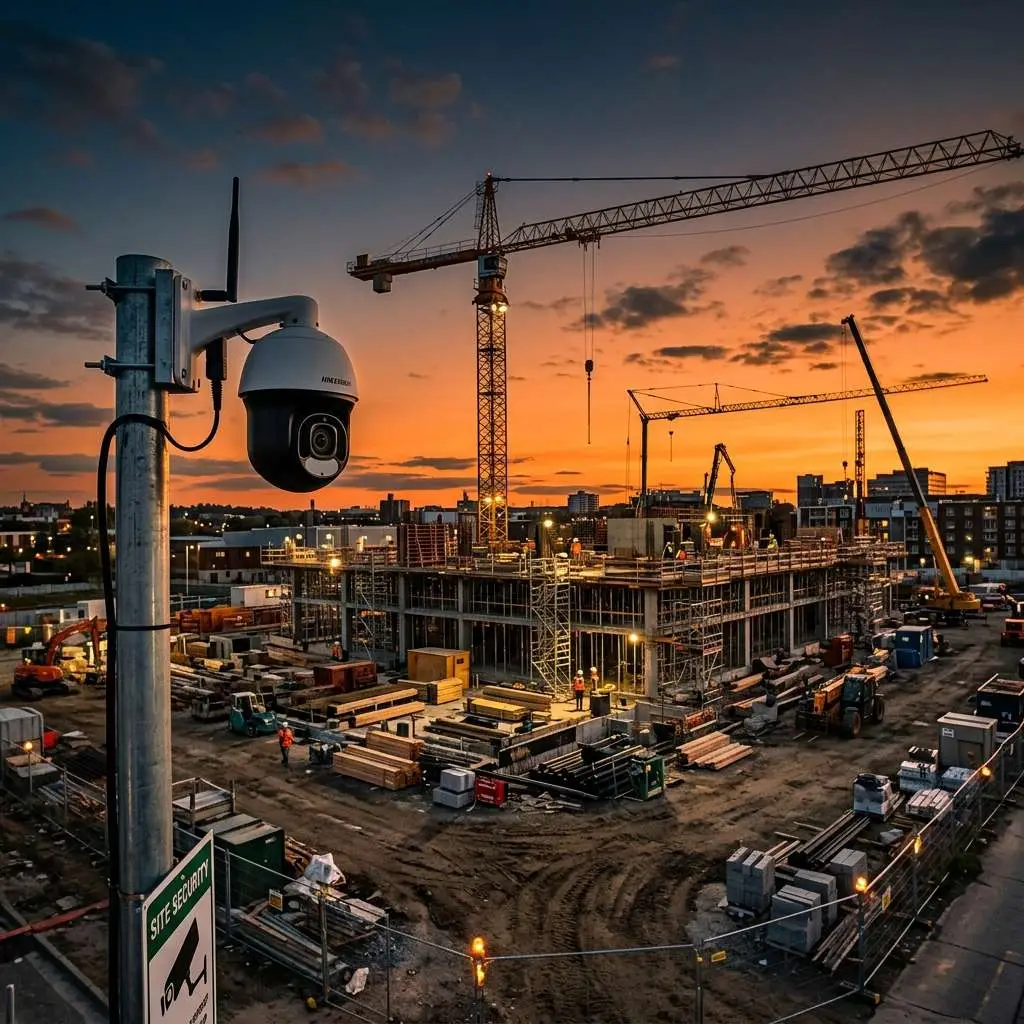
Construction sites are among the most vulnerable commercial properties in any market. Open lots, valuable equipment, stacks of raw materials, and rotating crews create an environment that’s nearly impossible to secure with traditional methods alone. After hours, when workers go home and the job site goes dark, the risk doesn’t disappear — it spikes.
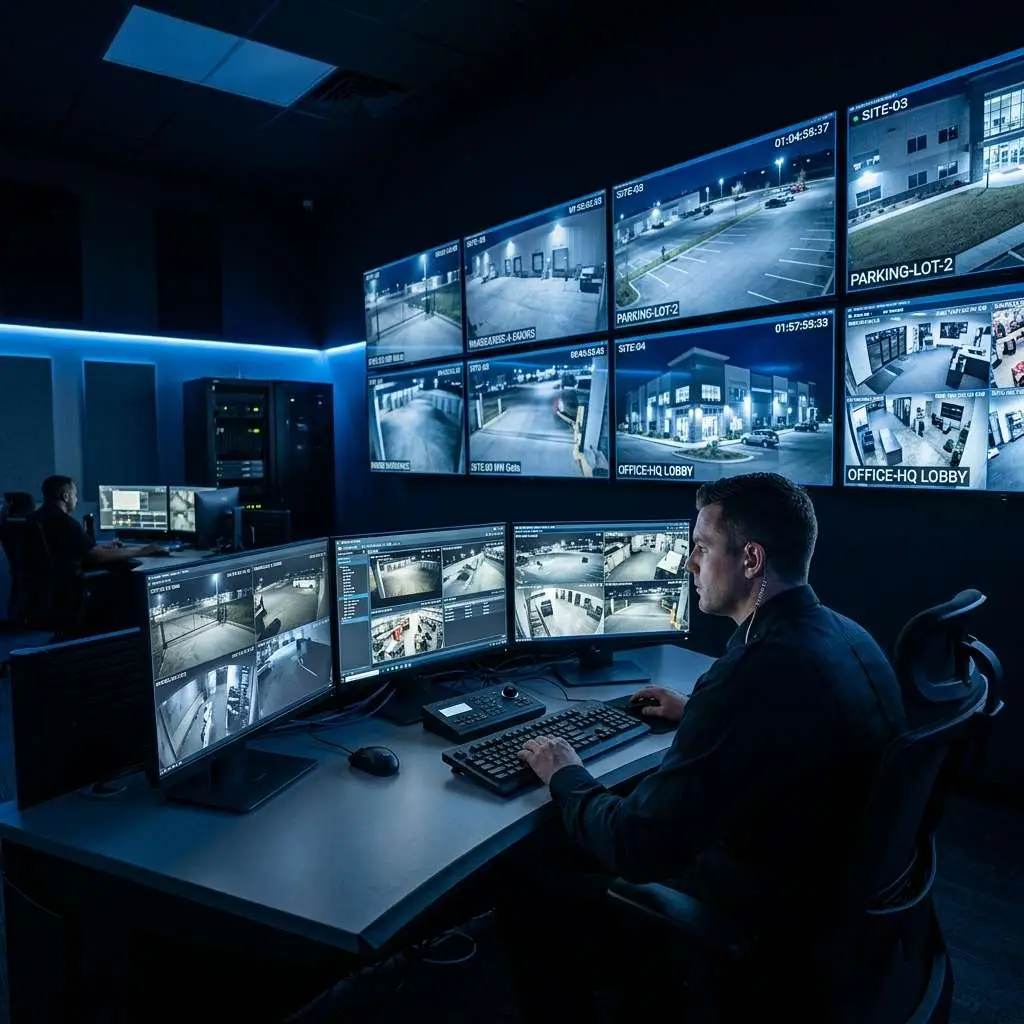
Remote video monitoring for construction sites addresses that gap directly. Multiple cameras, AI-assisted detection, and trained operators watching live feeds 24 hours a day can stop theft, vandalism, and trespassing in real time — without the cost of round-the-clock guards on every corner of the perimeter.
Why Construction Sites Are a Prime Target for Theft and Vandalism
The construction industry loses an estimated $1 billion or more each year to theft, according to industry data. The losses on any single site can range from $50,000 for a bad weekend to $500,000 or more for a coordinated equipment theft operation. Several factors make construction sites uniquely attractive to thieves:
- High-value materials left outdoors: Copper wire, lumber, roofing materials, and HVAC components can be removed quickly and sold for scrap or resale. Copper theft alone is a significant and growing problem across the Southeast.
- Heavy equipment with minimal tracking: Skid steers, generators, compressors, and excavators are worth tens of thousands of dollars each and are often left on-site overnight with basic cable locks.
- No permanent perimeter: Unlike a building with locked doors and alarm sensors, a construction site is typically enclosed only by temporary chain-link fencing — easy to breach.
- Unpredictable after-hours access: Subcontractors, delivery crews, and workers come and go at all hours. Unauthorized access blends in during the day and goes unchallenged at night.
- No witnesses after hours: Once workers leave the site, there’s often nothing to deter a determined thief except the slim possibility of police patrol.
Vandalism adds another layer. Graffiti, intentional equipment damage, and material destruction can delay projects and trigger costly insurance claims. Trespassers create liability exposure for the general contractor whether they’re thieves, teenagers, or homeless individuals seeking shelter.
Why Physical Guards Fall Short on Construction Sites
Hiring on-site security guards seems like an obvious solution, but the economics and limitations of physical guard coverage make it impractical for most construction projects.
A licensed security guard in the Southeast costs between $35 and $45 per hour. For 24/7 coverage, you need a minimum of four guards rotating in shifts — plus overtime, agency fees, and replacement costs when guards call out sick. The annual bill for round-the-clock guard coverage on a single construction site can easily exceed $300,000 to $400,000.
And that cost doesn’t guarantee protection. A guard on foot can only watch one area at a time. They have a single line of sight. An active construction site might span several acres with dozens of entry points, storage yards, and equipment staging areas — far more than one person can effectively monitor. If a theft happens in the northwest corner of the lot while the guard is doing a sweep of the southeast perimeter, the incident goes undetected until morning.
Guards are also a reactive resource: they can only respond to incidents they personally witness. Remote video monitoring, by contrast, watches everything simultaneously.
How Remote Video Monitoring Works on a Construction Site
Remote video monitoring is not simply a recording system you review after an incident. It’s active, live surveillance with a human response layer built in.
- Camera placement at critical zones: Cameras are installed to cover all entry and exit points, material storage areas, equipment yards, and perimeter fencing. Depending on site size, this might be 6 to 20+ cameras providing overlapping fields of view with no blind spots.
- AI-assisted detection: The system uses video analytics to detect motion and distinguish between relevant activity (a person on foot after hours, a vehicle entering without authorization) and false positives (an animal crossing, wind-blown debris). This filtering keeps operators focused on real threats.
- Live monitoring by trained operators: When the analytics flag an event, a trained monitoring operator reviews the live feed in real time — not a recording, but the live camera view at that moment.
- Two-way audio warning: If suspicious activity is confirmed, the operator activates two-way audio through speakers installed on-site and issues a verbal warning: “Attention — this is a monitored security site. You are being recorded. Leave immediately.” In most cases, this is enough to deter the trespasser.
- Police dispatch if needed: If the individual doesn’t comply, the operator calls local police and provides a live description of the subject, their location on the property, and direction of travel.
This sequence — detection, verification, audio deterrence, police dispatch — happens in seconds, not minutes. It’s a fundamentally different response model than any alarm system or recorded footage review.
The Mobile Surveillance Trailer Advantage
One of the most significant challenges with deploying remote monitoring on a construction site is infrastructure. Most active job sites don’t have permanent power or reliable internet service until the project is well underway — and that’s precisely when the site is most vulnerable, during early phases when materials are being delivered and equipment is staged.
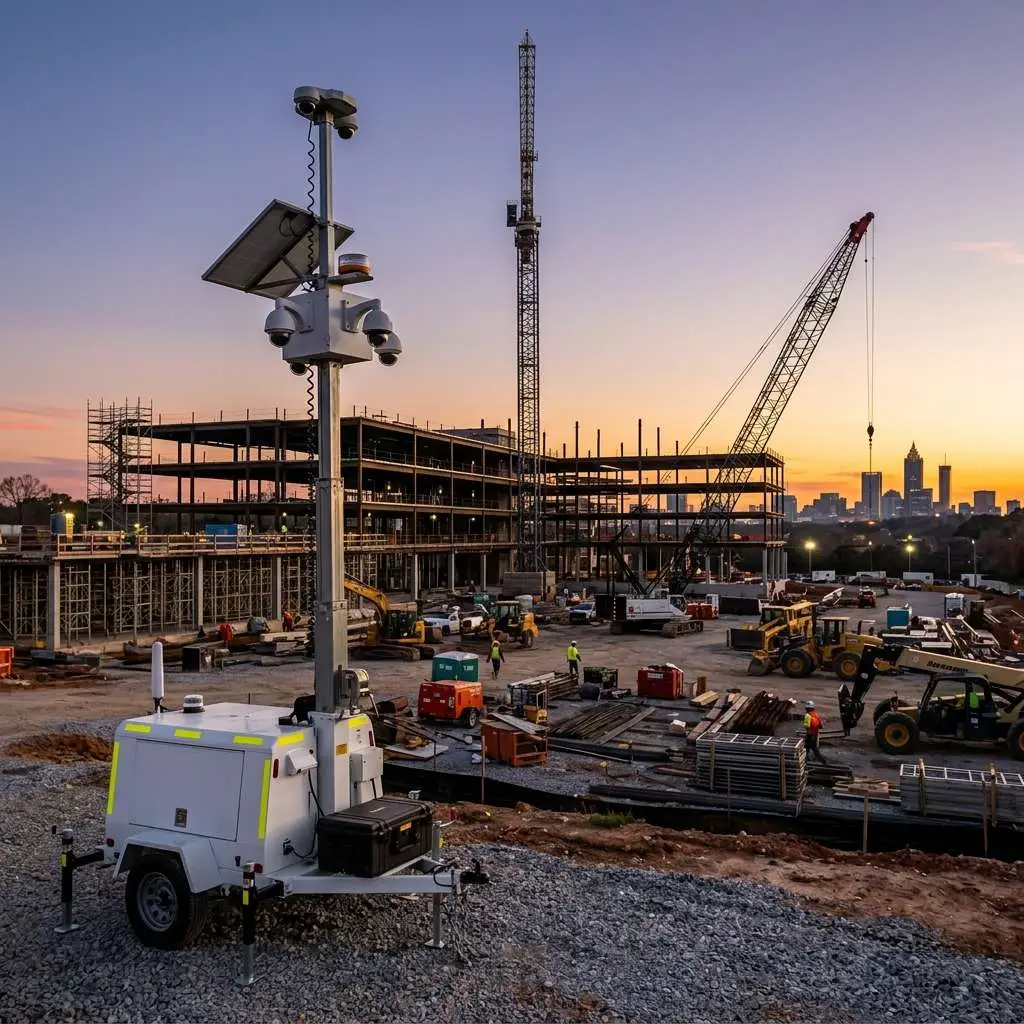
A mobile surveillance trailer solves this problem entirely. These self-contained units are solar-powered with battery backup, require no external power source, and use Starlink satellite connectivity to maintain a reliable uplink from virtually any location — including remote rural sites, highway construction zones, and undeveloped land parcels.
A trailer can be deployed in hours. It arrives on a standard trailer hitch, gets positioned at the most critical vantage point on the site, and is fully operational the same day. As the project progresses, it can be relocated to follow the work. When the project ends, it’s hauled off to the next site.
For construction companies managing multiple active job sites simultaneously, the ability to move coverage from a low-risk phase of one project to a high-risk phase of another makes mobile surveillance trailers an exceptionally cost-effective tool.
What Gets Monitored: Key Zones on a Construction Site
- Main access gates and entry points: Every vehicle and person entering or leaving the site passes through a fixed point. Camera coverage here creates a record of all access and flags unauthorized entry after hours.
- Material storage areas: Lumber piles, copper wire spools, roofing materials, and HVAC staging areas are high-value targets. These zones should have dedicated camera coverage from multiple angles.
- Equipment yards: Generator staging, skid steer parking, compressor storage — anywhere high-value equipment sits overnight needs active coverage.
- Temporary fencing perimeters: The weakest physical barrier on any construction site is the chain-link fence line. Camera coverage along perimeter sections deters breach attempts and captures incidents if they occur.
- Areas with documented after-hours activity: If your site has experienced previous incidents in a specific zone, that area should receive priority camera density.
The ROI Case: What Remote Monitoring Actually Costs
Remote video monitoring typically costs 60–80% less than 24/7 on-site guard coverage — while providing broader coverage across the entire site perimeter. A comprehensive remote monitoring program for a mid-size construction site — including camera hardware, installation, monitoring fees, and mobile trailer rental if needed — typically runs $1,500 to $4,000 per month. Full 24/7 guard coverage for the same site would cost $8,000 to $12,000 per month at minimum.
That savings becomes even more compelling when you factor in what’s being protected. A single theft incident involving copper wire from an active job site can run $10,000 to $30,000 in material losses plus project delay costs. Equipment theft can exceed $50,000 to $200,000 per incident. A properly monitored site that prevents even one significant theft event per year pays for itself many times over.
Insurance carriers are also beginning to recognize monitored sites as lower-risk properties, which can translate into reduced premiums for contractors who can demonstrate active 24/7 monitoring coverage.
What to Look for in a Remote Monitoring Provider
- Coverage hours: Is the monitoring genuinely 24/7, or does the service drop to recorded-only coverage during certain hours? Theft on construction sites predominantly occurs at night and on weekends — gaps in live monitoring are gaps in protection.
- Response protocol: Does the provider issue an audio warning before calling police, or do they go straight to dispatch? A verbal deterrence step stops most opportunistic incidents without police involvement.
- Camera quality and coverage planning: Ask about camera resolution, night vision capability, and whether a site assessment is done before deployment. Coverage planning matters — poorly placed cameras leave blind spots that experienced thieves will exploit.
- Mobile trailer capability: Can the provider supply a self-contained solar trailer for sites without existing power and internet infrastructure? This determines whether you can get coverage from day one of a project.
- Incident documentation: Does the system provide timestamped video clips and incident reports? These are essential for insurance claims and police reports.
Remote Monitoring + Mobile Trailer: Built for Construction
Construction sites present a unique combination of challenges: temporary infrastructure, large open perimeters, high-value targets, and constant change as the project progresses through phases. Remote video monitoring paired with a mobile surveillance trailer is the only security solution designed specifically to handle all of these variables at once.
For general contractors, site supervisors, and project owners who want real protection — not just the appearance of it — this combination delivers 24/7 coverage from day one of a project to final closeout, without the overhead of a full-time guard force.
Edge Business Security Cameras provides both virtual guard monitoring and mobile surveillance trailer rental for construction sites across Atlanta, Birmingham, Nashville, Houston, and the broader Southeast region. Our monitoring operations center operates 24/7, and our trailers can be deployed to active job sites within hours of a call.
Ready to protect your job site? Learn more about our virtual guard video monitoring service or explore our mobile surveillance trailer rental options — or contact us for a free site assessment.
Industries & Use Cases Hub
This guide is part of our Commercial Security Camera Solutions by Industry resource hub. Explore security solutions for restaurants, hotels, warehouses, retail, healthcare, and more.

About the Author
Kevin Harkins is the Director of Sales at Edge CCTV, where he has spent 10 years helping business owners design and implement commercial security camera systems across Atlanta, Birmingham, Chattanooga, and beyond. Starting as an Outside Sales Representative and working his way up through Sales Manager to Director of Sales, Kevin has guided hundreds of businesses through the process of evaluating, specifying, and installing the right system for their facility. More from Kevin Harkins.