Slip-and-fall fraud costs American businesses billions of dollars annually in fraudulent insurance claims, inflated legal settlements, and rising workers compensation premiums. Unlike theft, which typically produces clear evidence of wrongdoing, fraudulent fall claims are difficult to disprove without independent, objective documentation of exactly what happened and exactly when. Business security camera footage is the single most powerful tool available to business owners, insurance carriers, and defense attorneys when investigating the legitimacy of a slip-and-fall claim.
The Scale of Slip-and-Fall Fraud
Real accidents do happen, and businesses have a genuine duty to maintain safe conditions. The problem is that the financial stakes — workers compensation benefits, premises liability settlements, and medical expense reimbursements — create a persistent incentive for fraudulent claims. The National Insurance Crime Bureau identifies slip-and-fall fraud as one of the most common forms of insurance fraud. Staged falls occur in retail stores, restaurants, grocery stores, parking lots, office buildings, and warehouses. In some organized fraud schemes, professional “slippers” — individuals who stage falls as a source of income — have been documented filing claims against multiple businesses in the same geographic area over periods of months or years.
How Fraudulent Slip-and-Fall Schemes Work
The Solo Staged Fall
An individual identifies a location where a hazard exists — or creates one — and deliberately falls. They then report the fall to management and file a claim. Key elements that distinguish a fraudulent fall from a real one are often visible on camera: the person checking for cameras before falling, the fall appearing staged or theatrical rather than reflexive, or the person moving freely without apparent distress in the minutes before and after the fall.
The Planted Hazard
A person or an accomplice deliberately creates the hazard — spilling liquid, leaving an object in a walkway — then waits for the right moment to fall. Camera footage that captures the moment the hazard was introduced is definitive evidence against the claim. This is why continuous recording (not motion-triggered only) at key locations near high-traffic floor areas is important.
The Exaggerated Injury
A real fall occurs but the resulting injury is significantly exaggerated. Camera footage of the fall itself, the person immediate post-fall behavior (getting up quickly, walking normally, making phone calls), and the absence of the dramatic impact claimed are all valuable evidence for the defense.
Organized Fraud Rings
In more sophisticated schemes, multiple individuals work together — one stages the fall while another acts as a witness, sometimes with a third providing medical documentation. Camera footage is particularly powerful against these schemes because it captures all participants simultaneously and independently of their accounts.
What Security Camera Footage Can Prove
- Whether a hazard existed: Footage taken before the fall shows whether a spill, ice patch, or obstacle was present, how long it had been there, and whether employees had been in the area.
- Whether warning signs were present: Footage shows whether wet floor signs, caution cones, or barriers were deployed near the alleged hazard.
- The mechanics of the fall: Footage captures whether the fall appeared accidental and reflexive or staged and deliberate.
- Post-fall behavior: A person who claims a serious injury but is captured on camera walking briskly to their vehicle minutes later creates a significant inconsistency for their claim.
- Whether other people traversed the same area without difficulty: Multiple people walking through the area in the minutes before the claimed fall without incident weakens the premise that an obvious hazard existed.
Camera Placement Strategy for Slip-and-Fall Protection
- Entrances and wet-floor transition zones: The area just inside any entrance is a persistent slip-and-fall risk during wet weather. A camera with a clear view of this zone, capturing both floor level and the individual approach and fall, is essential.
- Checkout areas and high-traffic floor space: These areas generate the highest volume of customer-caused spills and are the most common sites for staged falls in retail environments.
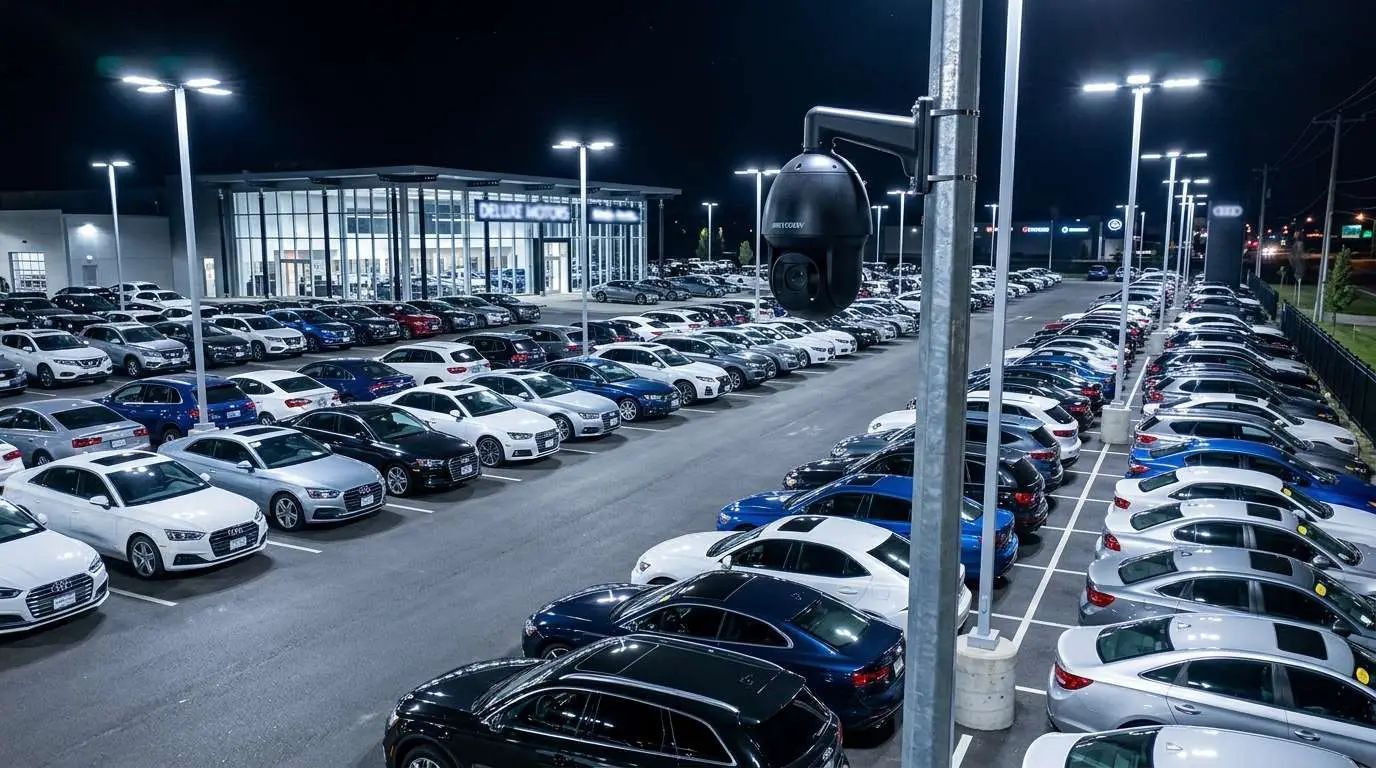
- Parking lots and exterior walkways: Outdoor falls — especially in winter conditions — are a frequent source of premises liability claims. Exterior cameras should have sufficient resolution to identify individuals from a distance.
- Loading docks and receiving areas: Workers compensation slip-and-fall claims in industrial and warehouse settings frequently involve loading areas. Cameras covering these zones serve both incident investigation and safety compliance purposes.
- Coverage overlap: Design your camera layout so that any location where a fall is likely to occur is covered by at least two cameras from different angles. A single-camera view that is partially obstructed provides much weaker evidence than overlapping coverage.
Recording Configuration for Incident Evidence
- Continuous recording, not motion-only: The moments before a staged fall — when the hazard is planted or the person surveys the area — are often the most revealing. Motion-triggered recording that activates only after the fall begins misses this context entirely.
- Adequate resolution: Footage intended for legal proceedings needs to be clear enough to identify individuals and show floor-level detail. A minimum of 2MP (1080p) is recommended; 4MP or higher is preferable for areas with large fields of view.
- Sufficient retention: A claim may not be filed for days or weeks after an incident. Retain at least 30 days of footage — 60-90 days is preferable for businesses with frequent customer or employee activity.
- Synchronized timestamps: Ensure your NVR system clock is synchronized to an NTP time server. Footage with an incorrect timestamp is significantly less useful in legal proceedings.
Responding to a Slip-and-Fall Incident
- Do not allow footage to overwrite: Immediately preserve the relevant footage by exporting it to an external drive or cloud storage. Do not rely on the NVR normal overwrite cycle to preserve it.
- Capture a wider time window than you think you need: Export footage from at least 30 minutes before the incident through 30 minutes after. Preparatory activity and post-fall behavior are often more revealing than the fall itself.
- Pull all relevant camera angles: Export footage from all cameras that could have captured any part of the incident or the individual approach and departure.
- Document the chain of custody: Note who exported the footage, on what date, and where it is stored. This matters for admissibility in legal proceedings.
- Share with your insurance carrier immediately: Your carrier investigators can use footage to evaluate the claim and, if warranted, refer it for fraud investigation.
Legal Considerations and Camera Placement Restrictions
Business surveillance cameras are generally lawful in Georgia and most states in areas where customers, employees, and visitors have no reasonable expectation of privacy. This includes sales floors, parking lots, entrances, warehouses, and production areas. Cameras are not permitted in restrooms, changing rooms, or other areas where a person has a reasonable expectation of privacy.
Posting visible camera notices — either physical signage or a notice in your employee handbook — is a best practice in most commercial environments and, in some states, a legal requirement. Consult with legal counsel if you are uncertain about the specific requirements in your jurisdiction.
The Broader Business Case
Detecting fraudulent slips and falls is just one reason businesses invest in commercial surveillance systems. The same cameras that protect you from a fraudulent claim also document legitimate accidents so you can improve safety conditions, verify that employees are following proper procedures, and demonstrate to your workers compensation carrier that you maintain a safe workplace. Businesses with documented safety protocols and active surveillance systems often qualify for lower insurance premiums over time.
A well-designed commercial security camera system is one of the most cost-effective risk management investments a business can make. For a consultation on camera placement, recording configuration, and footage retention practices for your facility, contact Edge CCTV.
More in this series
Camera Laws in Georgia|Warehouse Camera Placement|Installation Cost in Atlanta|Before You Install Cameras
Related Guide
{“@context”:”https://schema.org”,”@type”:”Article”,”headline”:”Using Video to Spot Slip-and-Fall Fraud”,”url”:”https://edgebusinesssecuritycameras.com/using-video-to-spot-slip-and-fall-fraud/”,”datePublished”:”2023-01-15″,”dateModified”:”2026-06-22″,”author”:{“@type”:”Organization”,”name”:”Edge CCTV”,”url”:”https://edgebusinesssecuritycameras.com”},”publisher”:{“@type”:”Organization”,”name”:”Edge CCTV”,”url”:”https://edgebusinesssecuritycameras.com”,”logo”:{“@type”:”ImageObject”,”url”:”https://edgebusinesssecuritycameras.com/wp-content/uploads/2025/10/Edge-Logo-696×696-1.webp”}},”mainEntityOfPage”:{“@type”:”WebPage”,”@id”:”https://edgebusinesssecuritycameras.com/using-video-to-spot-slip-and-fall-fraud/”}}

About the Author
Kevin Harkins is the Director of Sales at Edge CCTV, where he has spent 10 years helping business owners design and implement commercial security camera systems across Atlanta, Birmingham, Chattanooga, and beyond. Starting as an Outside Sales Representative and working his way up through Sales Manager to Director of Sales, Kevin has guided hundreds of businesses through the process of evaluating, specifying, and installing the right system for their facility. More from Kevin Harkins.