Gas stations operate around the clock, handling cash, fuel, lottery tickets, and an unpredictable mix of customers at every hour. They face a unique combination of risks that most other businesses do not: drive-offs at the pump, card skimmer installations on fuel dispensers, high shoplifting rates in the convenience store, and a lone overnight attendant who may be the only person on site for hours. A well-designed security camera system addresses every one of these vulnerabilities — but only if the cameras are placed correctly and the footage is actually usable.
This guide walks through the specific camera placements that matter most for gas stations and convenience stores, what each position captures, and why continuous recording combined with remote monitoring delivers the greatest protection for operators who cannot staff their location 24 hours a day with multiple employees.
Pump Island Coverage
The pump island is the highest-priority camera zone at any gas station. Every active fuel dispenser should have a dedicated overhead camera, typically mounted on the underside of the canopy above each pump island. The goal is to capture a wide-angle view that includes the pump number, the vehicle pulled up to it, and ideally a clear view of the driver as they exit the vehicle.
For drive-off documentation — one of the most common financial losses at gas stations — pump island cameras are essential. When a vehicle leaves without paying, the footage needs to show which pump was involved, what the vehicle looks like, and the approximate time of the incident so the attendant and responding investigators can match the record to a transaction log. A camera mounted too high or pointed at the wrong angle may capture only a rooftop view that is useless for identifying even the vehicle type.
Best practice is to position pump canopy cameras so they capture a 45-degree downward angle toward the pump and the area around it. This framing allows the camera to simultaneously cover the pump handle interaction (relevant for skimmer detection discussed below), the vehicle parked at the dispenser, and the customer’s general appearance. For stations with long pump islands — six or eight dispensers in a row — plan on one camera per two-dispenser island section, or dedicated cameras per dispenser on high-volume sites.
Wide Dynamic Range (WDR) technology is not optional at pump islands — it is a requirement. The bright canopy lighting directly above creates extreme contrast between the illuminated pump area and the darker surroundings, and standard cameras blow out the image or crush the shadows in ways that make footage unreliable. WDR cameras handle this by processing the bright and dark zones separately and combining them into a usable image. More on this in the canopy lighting section below.
Drive-Offs and Exit Coverage
A dedicated exit camera positioned to capture vehicles leaving the property is a critical complement to pump island cameras. Where the pump island camera documents which vehicle was at the pump, the exit camera documents the vehicle leaving — capturing its make, model, color, and general profile from a consistent angle as every vehicle passes through the exit lane.
It is important to be direct about what exit cameras do and do not do. Exit cameras capture clear video footage that investigators can use to identify a vehicle involved in a drive-off. However, they do not automatically read license plates, and Edge CCTV does not install or represent any system that promises automatic plate recognition for this purpose. What investigators and law enforcement receive is high-quality footage — frame-by-frame images of a departing vehicle that human reviewers can use to identify make, model, color, and any distinctive features. That footage assists investigators significantly compared to having no exit coverage at all.
Exit camera placement matters. The camera should be mounted at a height and angle that captures the front of the vehicle as it exits, not just the roof or the rear bumper. If your station has multiple exit points, each one needs coverage. A single camera pointed at the wrong exit lane may miss the vehicle entirely. In practice, most stations have one or two exit points, and a camera mounted 10 to 14 feet high at the edge of the canopy or on a dedicated pole can cover the exit lane effectively.
Interior Register Coverage
The interior of the convenience store is a high-activity area with multiple loss vectors: shoplifting, employee theft, counterfeit bills, and disputed transactions. The primary camera inside the store should be positioned to capture the point-of-sale counter — specifically a face-level view that shows the cashier and the customer standing at the register simultaneously.
Face-level register cameras serve several functions. First, they deter theft by making it visually obvious to anyone approaching the counter that they are being recorded clearly. Second, they provide documentation for cash disputes — if a customer claims they gave the cashier a larger bill and received incorrect change, the camera footage can resolve the dispute. Third, they capture the full transaction context, including any items visible on the counter that may relate to a later dispute.
Many gas stations also keep lottery ticket dispensers and scratch card racks near the register. Including this area in the register camera’s field of view is worthwhile. Lottery-related theft — where a customer distracts the attendant while an accomplice pockets tickets — is a documented pattern in convenience retail. A camera that captures both the register and the lottery display area in one frame reduces blind spots significantly.
For stores with self-checkout kiosks, each kiosk should have its own overhead camera in addition to the register camera. Self-checkout areas are a known shoplifting vulnerability, and overhead coverage of the scan-and-bag area provides documentation of what was and was not scanned.
Beer Cave and Walk-In Cooler
The beer cave — or walk-in cooler — is consistently one of the highest shoplifting zones in convenience store operations. The enclosed space, the products stacked floor-to-ceiling, and the tendency for multiple customers to enter simultaneously create conditions where items walk out under jackets, in oversized bags, or simply carried in hand to the exit without being paid for.
A camera mounted at the entrance to the walk-in cooler, positioned to capture both the interior and the doorway, covers this zone effectively. The camera needs a wide enough angle to show the full interior of the cooler — not just the door — so that it captures what a person picks up, whether they conceal it, and whether they exit with it in hand. If the cooler is large enough, a second interior camera mounted in the far corner provides overlapping coverage that eliminates blind spots behind cooler doors and shelving units.
In addition to deterrence, cooler cameras provide documentation for inventory discrepancy investigations. When a week’s beer inventory is off by a meaningful amount and the operator suspects internal shrinkage, having time-stamped footage of who entered the cooler during which shifts is a practical investigative tool.
Exterior Perimeter
The exterior of the gas station — beyond the pump canopy — includes entry and exit driveways, the dumpster enclosure, any ATM or kiosk on the property, and the side and rear walls of the building. These areas are often undercovered in standard camera installations, but they are active areas for after-hours incidents, property damage, and trespassing.
Every vehicle entry and exit point should have a camera. This includes side lot entrances, service vehicle entry points, and any secondary access road that connects to the property. Perimeter cameras at these points document who enters the property and when — useful context for any incident that occurs on-site.
The dumpster area deserves specific attention. Illegal dumping is a persistent problem for commercial properties, and gas station dumpsters are a frequent target. A camera pointed at the dumpster enclosure creates a visible deterrent and provides documentation for any waste management disputes or incidents of dumping hazardous materials.
If the station has an ATM — whether owned, leased, or operated by a third-party — that ATM requires its own camera coverage. ATM areas are targets for physical attacks (ram-raids, crowbar removal), card skimming devices installed on the ATM card reader, and customer-level crimes including robbery. A camera mounted to capture the ATM fascia and the area directly in front of it provides both deterrence and documentation for any incident at the machine.
Skimming Prevention
Card skimmer installation on fuel dispensers is a significant and growing problem for gas station operators. Skimming devices are physically attached to pump card readers — typically in under 30 seconds by someone who appears to be a paying customer — and capture card data from every legitimate transaction that follows. The financial losses to customers and the liability exposure to the station operator can be substantial.
Cameras cannot automatically detect skimmer installation attempts — no camera software reliably identifies the act of placing a small device on a card reader in real time. What cameras do is create a documented record of every person who interacts with each pump’s card reader area. When a skimmer is discovered, investigators pull back the footage to identify when it was installed and who installed it. Multiple camera angles on each pump — especially a dedicated view of the card reader side of the dispenser — make this forensic review far more productive than footage from a general overhead camera that may not show the card reader clearly.
The deterrence effect is also real. Skimmer installations by organized rings tend to target stations with minimal or visible-only camera coverage. Stations with cameras clearly mounted at each pump island — including angles that face the card reader — are frequently passed over in favor of softer targets. This is not guaranteed protection, but it is a meaningful risk reduction factor that operators should weigh when planning their system.
In addition to cameras, operators should brief their staff on inspecting pump card readers regularly — a visual check for any device that feels loose, protrudes unusually, or does not match the appearance of the other dispensers. Camera documentation and human inspection work together; neither replaces the other.
Canopy Lighting and Night Vision
Gas station canopies are typically equipped with high-intensity lighting — metal halide, LED, or fluorescent — that makes the pump area brightly lit at night. This is good for safety and visibility for customers, but it creates a serious challenge for standard security cameras: the bright canopy ceiling and the darker surroundings (the road, the parking lot, the far end of the property) create an extreme contrast ratio that most cameras cannot handle simultaneously.
A standard camera pointed at a bright canopy ceiling will either expose for the bright areas — leaving the darker surroundings completely black — or expose for the darker areas and completely blow out the pump island. Either way, the footage is not usable for the purposes it was installed to serve.
Wide Dynamic Range cameras solve this problem by capturing multiple exposures simultaneously and combining them in the image processor. The result is a single frame where both the brightly lit canopy area and the darker surrounding perimeter are visible at usable exposure levels. For gas stations, WDR cameras are not a premium upgrade — they are a baseline requirement for any camera positioned near or under the canopy.
For cameras positioned away from the canopy — covering the exterior perimeter, dumpster area, or exit lane — infrared night vision is the appropriate technology. These cameras switch to IR mode automatically when ambient light drops below a threshold, providing clear footage in complete darkness. The effective IR range varies by camera model and site conditions, so camera selection should account for the actual distances involved at each exterior position.
24/7 Continuous Recording
Gas stations are open 24 hours a day, 365 days a year. The nature of the business means there is no quiet period when risk drops to a manageable level. After-hours incidents — vandalism, pump skimmer installation, vehicle break-ins, and trespassing — frequently occur precisely because staffing is at its minimum and the property appears less monitored.
For high-risk commercial sites like gas stations, continuous recording is the correct approach. Motion-triggered recording — where cameras only record when they detect movement — sounds efficient on paper but creates significant gaps in coverage at an active fuel site. Every passing car on an adjacent road, every flag or sign moving in the wind, and every person walking past the property can trigger or fail to trigger recording in ways that leave incident documentation incomplete.
Continuous recording ensures that every moment is documented, regardless of whether the motion detection algorithm recognized the event as worth recording. When an incident is investigated — whether hours or days after it occurred — the footage is there. The storage requirements for continuous recording are higher, but the cost of modern NVR storage is a minor consideration compared to the liability exposure or financial loss from a single undocumented incident.
A properly sized NVR with adequate hard drive capacity should retain at least 30 days of continuous footage across all cameras. For high-transaction sites with ATMs or documented skimming history, 60 to 90 days of retention is worth the additional storage investment.
Remote Monitoring for Overnight Staff
Many gas stations operate overnight with a single attendant — one person managing the register, the pumps, and the entire property for a six-to-eight-hour shift. This is a genuine safety risk. A lone overnight attendant is a more vulnerable target for robbery than a fully staffed store, and if an incident escalates, there may be no one else on site to call for help or respond.
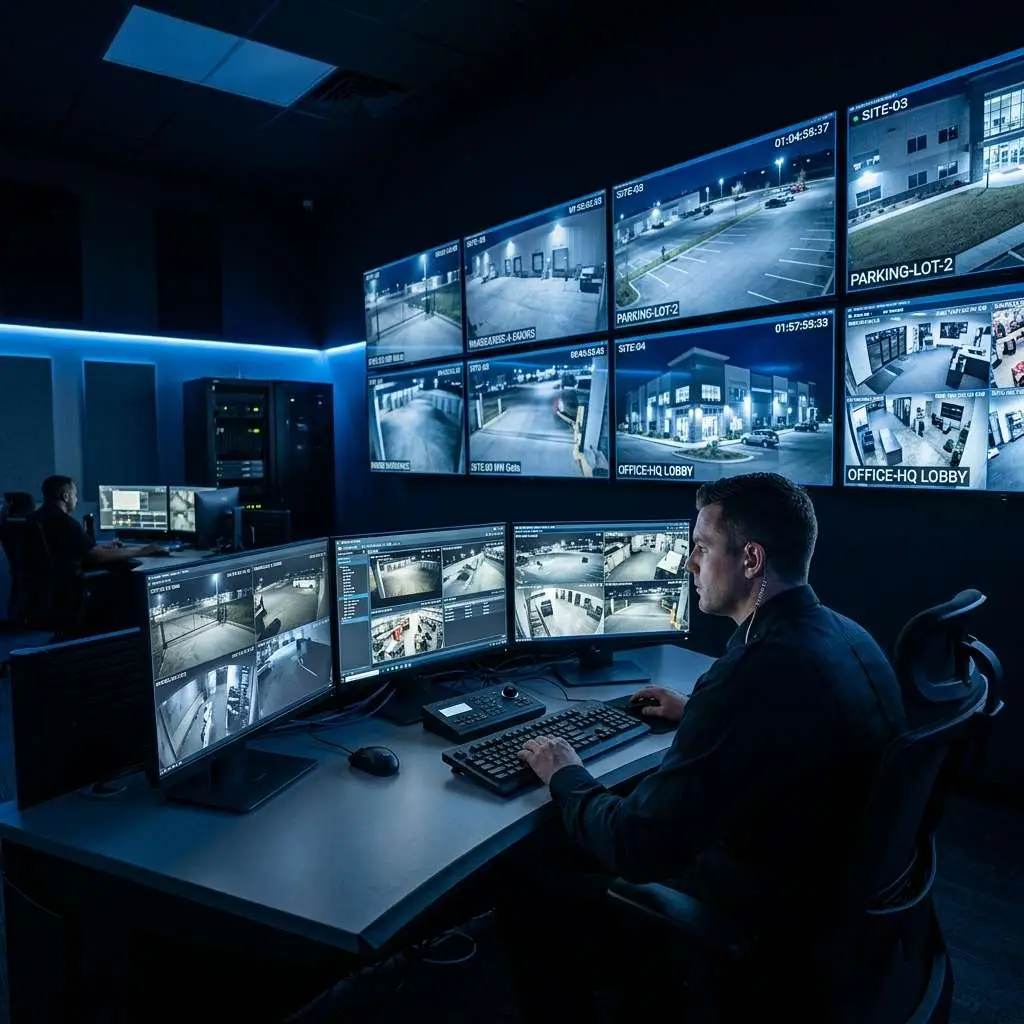
Remote monitoring — where a professional monitoring center watches live camera feeds from the station on an ongoing basis — adds a virtual presence to the property during these high-risk hours. When a monitoring operator sees suspicious behavior developing at the pump island, in the parking lot, or at the entrance to the store, they can intervene via an on-site speaker or initiate a call to local law enforcement with real-time visual context about what is happening.
This is meaningfully different from a recorded-only camera system. With standard recording, the attendant is still alone in the store, and the cameras document what happened after the fact. With remote monitoring, there is an active human presence — off-site but watching and able to respond — that changes the risk calculus for anyone considering a crime of opportunity against the property or the attendant.
For gas station operators running overnight shifts with minimal staffing, remote monitoring deserves serious consideration as part of the camera system design. The combination of comprehensive camera coverage and live remote monitoring creates a layered safety net that neither cameras alone nor staffing alone can provide.
More in this series
Retail Security After Dark • Nightlife Venue Security • Automotive Dealership Security • Construction Site Theft Prevention
Related Guide

About the Author
Kevin Harkins is the Director of Sales at Edge CCTV, where he has spent 10 years helping business owners design and implement commercial security camera systems across Atlanta, Birmingham, Chattanooga, and beyond. Starting as an Outside Sales Representative and working his way up through Sales Manager to Director of Sales, Kevin has guided hundreds of businesses through the process of evaluating, specifying, and installing the right system for their facility. More from Kevin Harkins.